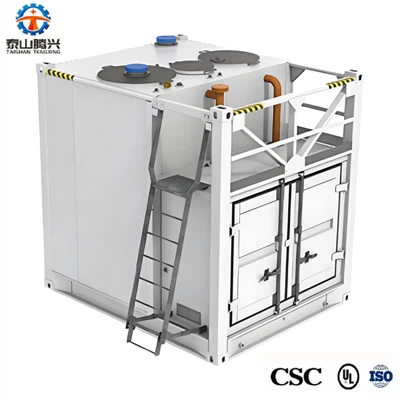
Hey there! As a supplier of 40 FT ISO Tanks, I'm super stoked to chat with you about the flow control devices for these bad boys. You know, 40 FT ISO Tanks are pretty amazing pieces of equipment. They're widely used for transporting all sorts of liquids and gases, from chemicals to food products. And having the right flow control devices is crucial to make sure everything runs smoothly and safely.
Let's start with the basics. First up, we've got the valves. Valves are like the traffic cops of the 40 FT ISO Tank. They control the flow of the substances inside the tank. There are different types of valves you can use. One common type is the ball valve. It's simple and effective. The ball inside the valve has a hole in it. When you turn the valve handle, the ball rotates. If the hole aligns with the pipe, the flow is on. When you turn it so the hole is perpendicular to the pipe, the flow stops. It's a pretty straightforward way to control the flow, and it's reliable too. You can find more info about 40 FT ISO Tanks on our 40 FT ISO Tank page.


Another type of valve is the gate valve. This one works by raising or lowering a gate inside the valve body. When the gate is fully raised, the flow is unrestricted. But when you lower the gate, it blocks the flow. Gate valves are great for applications where you need a full - open or full - closed situation. They're not really meant for throttling the flow, though, because if you only partially open the gate, it can cause erosion and wear on the valve.
Now, let's talk about regulators. Regulators are used to control the pressure of the substance flowing out of the tank. They make sure that the pressure stays at a safe and consistent level. For example, if you're transporting a gas in a 40 FT ISO Tank, you don't want the pressure to be too high when it's being transferred to another container or system. A pressure regulator will reduce the high - pressure gas in the tank to a lower, more manageable pressure. There are different kinds of regulators, like spring - loaded regulators. These use a spring to control the opening and closing of a valve inside the regulator. As the pressure changes, the spring compresses or expands, adjusting the valve to maintain the set pressure.
Flow meters are also important flow control devices. They measure the amount of fluid or gas that's flowing through the pipes connected to the 40 FT ISO Tank. There are several types of flow meters. One popular type is the magnetic flow meter. It works based on Faraday's law of electromagnetic induction. When a conductive fluid flows through a magnetic field created by the meter, a voltage is induced. The magnitude of this voltage is proportional to the flow rate of the fluid. This allows the meter to accurately measure how much fluid is passing through. Flow meters are essential for keeping track of how much product is being transferred, which is important for inventory management and billing purposes.
Check valves are another key component. They're like one - way streets for the substances in the tank. A check valve allows the fluid or gas to flow in only one direction. If there's any backflow or reverse pressure, the valve will close automatically. This is really important for preventing contamination and protecting the equipment connected to the tank. For example, if you're transferring a chemical from the tank to a processing unit, you don't want the chemical to flow back into the tank if there's a pressure change in the processing unit.
Now, let's touch on the importance of these flow control devices in the context of a 40 FT ISO Tank. These tanks are designed to meet international standards, which means they need to be safe and reliable. The flow control devices play a huge role in ensuring that. They prevent leaks, control the flow rate and pressure, and protect the integrity of the tank and the substances inside. For instance, if a valve fails, it could lead to a spill, which is not only a waste of product but can also be a safety hazard, especially if it's a hazardous chemical.
When it comes to choosing the right flow control devices for a 40 FT ISO Tank, there are a few things to consider. First, you need to think about the type of substance you're transporting. Different substances have different properties, like viscosity, corrosiveness, and flammability. For example, if you're transporting a highly corrosive acid, you'll need valves and other devices made from materials that can resist corrosion, like stainless steel or certain types of plastics.
You also need to consider the operating conditions. What's the temperature and pressure inside the tank? What's the flow rate you need to achieve? These factors will determine the size and specifications of the flow control devices. For example, if you're operating in a high - temperature environment, you'll need devices that can withstand the heat without losing their functionality.
If you're thinking about getting a 40 FT ISO Tank or need to upgrade the flow control devices on your existing tank, we've got you covered. We offer a wide range of high - quality flow control devices that are specifically designed for 40 FT ISO Tanks. And if you're interested in the tank itself, check out our 40 FT ISO Container page.
We understand that every customer's needs are different, so we're more than happy to work with you to find the best solutions for your specific situation. Whether you're in the chemical industry, food and beverage industry, or any other industry that uses 40 FT ISO Tanks, we can help you make sure your flow control is top - notch.
So, if you're interested in learning more or starting a purchase, don't hesitate to reach out. We're here to answer all your questions and get you set up with the right flow control devices for your 40 FT ISO Tank.
References
- Industry standards and guidelines for ISO Tanks
- Manufacturer's specifications for flow control devices